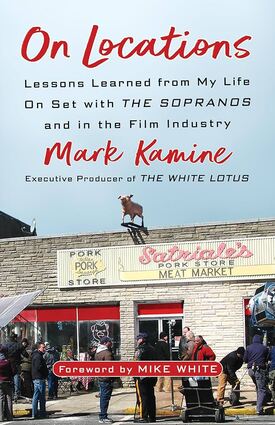
2024 marks the 25th anniversary of The Sopranos as Mark Kamine has published and released an intriguing non-fiction book about his experience on the hit HBO TV Series. The book is titled "On Locations: Lessons Learned from My Life On Set with The Sopranos and in the Film Industry". It's currently available wherever book are sold.
Kamine was the leader responsible for finding real-life exterior and at times interiors of the show's shot. So, take this time to get to know more about Kamine (who is currently the executive producer of the popular TV series "The White Lotus") and discover why you should read his true story about his experience with James Gandolfini, and overall the industry, right away.
1. In one word, how would you sum up your overall experience writing and releasing your book?
Dreamy.
I've been writing my whole life. Not necessarily for a living and the book acceptance was just crazy coincidence and worked out like a dream. My cousin of my wife's had a neighbor who was a publisher. The publisher mentioned if I ever had a book that we thought was of interest to reach out to her. He was interested since it was The Sopranos.
2. What was your writing schedule when you wrote this book?
I work in the film business still, and it can be very long hours. I've written book reviews, mostly in essays over the course of my film, work life, but about literature, mostly, some stuff about movies and other related and so I'm used to writing with a few minutes at a time when I can when I'm working on weekends. I wrote a good part of this book, big chunks of it during COVID Lockdown. So I was able to get a more regular schedule to finish it, leading up to December of 2023 right was when I finished it.
3. In your book, you have The New York Times quote from David Chase that said “I’ve always been anxious, fearful, competitive, envious, and angry.” Why did you decide to put that quote in your book?
A couple of reasons. First of all, I loved it when I first read it the year that it was quoted in the times when I was working on Sopranos and, and I think I laughed out loud when I read, David saying that you know, he was someone was really hitting the peak of his success and fame and, and to take that moment to express that kind of feeling like which was very honest.
And in the book, I talked about the frustrations of being stuck in a position that for a long time that I wanted to move on from. I wanted to be a writer for so long and was only maybe a quarter or a half of a writer because, I was able to publish previews very steadily and fortunately for the original editor at The Times, Literary Supplement that I wrote for, and then they continued to reach out to me. New York Times editors sort of picked me up and dropped me off here and there, but I had some kind of feeling of lack or envy or jealousy about the writing life too. So, it fit a lot of aspects I think, where I was at in the period that I described in this book.
4. What was your favorite on set location during your time working in The Sopranos?
In the book, I talk about the college episode, which was the 5th episode of the first season. It was pretty famous episode at the time because it was so great and it was so unusual. Location-wise, it was one that really clicked in a lot of ways. Half of the story took place with Tony and his daughter story visiting colleges in Maine. And we don't usually travel to somewhere like Maine when we're filming a show in New York. So, we had to find the right things. Drew University in New Jersey, had a few different looks and we use that as three different colleges. There was a motel that was on the outskirts of the town I grew up in that was sort of along a river and just had a very uncharacteristic feeling from suburban New Jersey. And that was one that I thought that could work as one of these motels. Again, I wasn't always involved in picking locations as to location manager, I was managing the scouts, who were looking for things and trying to give them guidance. So that episode, as a whole, was a great location episode, the little small town that we found in Lower upstate New York as a main town. It was really convincing I think, and contributed to the great script performances that made that episode.
5. What was the best lesson you learned from The Sopranos set and what was the worst lesson you learned?
I learned from The Sopranos, which I think I absorbed pretty well, was to try to work on good projects. I talked about in the book, like, have a film career that's freelance, you take jobs as they come along. And if you need a job, you don't always get to choose something that you think is maybe worthy, and you work long hours and spend a lot of time and a lot of time away from your family. And so to do that, I think The Sopranos made me feel like not that I didn't take jobs. I needed a job after that, but I was much more willing to pass things by that I didn't think were worth the time. As you're working on it and reading the scripts(The Sopranos) and seeing the actors before and the directors, like a great tip of directors we had on that do their jobs. You think like "Okay, why would I work on something that just from the start reading, the script is inferior to you know what you think it could be?" So, that was the lesson I learned. That was the best lesson.
The worst and the bad behaviors and examples that you take, like my own personal I mean, not anyone else's. You know, the kind of, withholding information that you do, and, you know, to maybe get get access to a location. You know, like, it's sort of deceptions that you practice as part of business. I always feel disappointed in myself, but I'm not more straightforward sometimes. You know, on the other hand, every, every position I've had to film as I've moved up, and now I'm producing, there's an element of you can't tell everyone everything and you can't be totally completely honest with everyone about everything. Your goal is for the job to go smoothly and for the work to get done. And it doesn't sometimes help everyone knows whatever. How people really feel about them or whatever problems you have that might you see coming that you don't want to tell people about. I got better. I mean, I talked in the book about just little cheats and things that you do and that's always hard to look at yourself when you do that kind of stuff.
6. What mistake did you recall making when you work on the first season of The Sopranos?
There is a story I told in the book, we were filming at a funeral home in New York City for a scene. Junior Soprano was Tony's uncle, his father's brother, and he's an older mobster, played by Dominic Chianese. He makes a comment about the woman who's in the casket and it was a kind of a racist and sexual comment. It was a sexual comment about her past life with him that was pretty inappropriate in the circumstance and really very funny. The funeral parlor owner( actual business owner) heard the rehearsal or saw the script page and said to my assistant, an old friend of mine, Mike King, "You can't say that here in my business. This is a family-owned and run business. And we're very proud here and I don't want anyone saying that." Mike explained to him, "It's fictional. It's not even in New York. It's supposed to be New Jersey, has nothing to do with your business." It didn't work. The owner refused to let the actor say the line. Eventually, David Chase was contacted and he decided he didn't want change line, so we got thrown out. We did not get to finish the scene.
That's the big mistakes you can make on movies, getting thrown out of a location if you're a location department or location manager, because that's really costly. After that incident happened, we decided to let everyone know that this show has some nasty stuff in it and it has some bad language and it has guys doing criminal activities. If you have a problem with that, you shouldn't sign this contract. At least we're up front and you might be the location we want, but you're not going to let us do the job and we're better off going somewhere else. That was what we should have done from the start, warned people what was going to happen.
7. Did you get into the film industry as a location assistant in the book-based film “Quiz Show”? If not, could you talk about how you got into the industry?
I did. I worked and didn't work. I was unemployed a lot in my 20s. In New York, I was a superintendent in the building. I didn't have to earn a lot of money. I had a free apartment. I kind of had a career that didn't exist. It wasn't going anywhere in my writing. I did and I was publishing a little bit here and there, but you don't make money mostly when you're writing and I wasn't. So, I did all kinds of odd jobs and collected unemployment. In the 80s independent film became a movement and Sundance Film Festival and NYU--Spike Lee went there, Jim Jarmusch were a couple of the big filmmakers that went to the program that I applied to. I became aware that this was a possible career and it's something I love, movies. It's sort of a creative field and maybe I could write movies. That's not what ended up happening. It wasn't what I found I was best at or even interested in. I had a more of a production organism. I did a small movie through a friend of my wife, who was a producer in New York. That was my first job on a movie although it was a very small budget. I got fired, because I didn't know what I was doing. Then I got rehired a few days later, the producer called me back and said, "The guy we hired to replace you is worse than you at the job. So, will you come back?" I finished that job and then I worked for free for a producer who said "I'm going to put you in the location department. What if any of my projects start? Because you've been working for free." "Quiz Show", which Robert Redford directed, was the first project that took off and he put me in the location department. And that was a pretty big New York job. I met the location film community in New York, through that job. I learned the job from them. I learned what to do and and how to approach it and then as we started filming, I was put on set at a very low level, assisting cleaning bathrooms setting up tables and chairs, but I learned all the steps of making a movie of that size from the location standpoint.
8. This year would mark the 11th anniversary since James Gandolfini passed away. Could you tell us how you first heard the news that he passed away in Rome, Italy?
The way everyone in the world or the United States heard the news, either a radio announcement or news release. After that, there was a lot of communication among people who had worked on the show. And then there was a memorial service announced, then funeral at the Cathedral of St. John the Divine in New York. My wife and I and the cast of the show attended. David Chase spoke and some other people spoke there. It was very sad.
9. Your book talked about your fondest memories of James Gandolfini both the good and bad which is human as we are all not perfect being. Could you just express the importance for you to mention your experience with the actor in your book?
Well, he was such a central part of the show. I was not close to him. I knew him through the show, a little better as the years went on, but he was so great and so central. You couldn't really write about The Sopranos without talking about James Gandolfini and David Chase. James was a complicated person, also kind of fascinating and interesting. So whatever what little experience I have and saw, I wanted to recount.
10. What do you want readers to take away after reading your book?
I want them to get a sense of the behind the scenes work that goes into projects, movies and TV shows. I was a sort of mid level position and lower at the beginning of the book, like the ground level position. There's a lot of movie and TV books told by or written about stars, directors and people in the highest positions of power. I read those books and love them, I love the gossipy books too and the Tell-All, but that's not what I wanted to do here. I really wanted to portray the business from the perspective of a position, more in the middle, and get that sense of being involved in a very public business, but really in a very safe and private way. For example, how you feel, what goes on, what goes on in preparation for the actors and the directors showing up and after they leave, in the office and and then how that weaves into having a normal, family life of a sort. How does that all fit together? Mainly, I want people to come away with a book experience. Hopefully, it's well written, clear, and create some curiosity about the business. Also, show the human side of the business and not the public, flashy, controversial side.
11. You were the co-producer of the book-based film “Silver Lining Playbook, could you talk about how you discovered Matthew Quick’s book and the experience adapting it on the screen?
I don't know how David Russell discovered the book "Silver Linings Playbook." I had worked on a previous job with David, "The Fighter", which was a great movie. When "Silver Linings Playbook" became his next project, he reached out to me. His producers also got in touch with me. I read the script, which was amazing, David is a great writer. So, I signed on, since I had such a great experience on The Fighter. That was an obvious easy call, The Fighter was a great movie, it won Awards, got nominations. Silver Linings Playbook was a great script that David wrote , so it just an easy yes for me. I did my thing at the time production, managing, co-producing, which was doing a rough version of the schedule, and a budget. Then sharing that budget with my accountable and producer George power. And, going through what we needed and did a different job that I had moved into at that time.
12. If you could executive produce any TV or even film adaptation, any book novella or even a short story or article, which one would you like to do?
I mean, you can't be at the job I have right now. I'm in Thailand on the White Lotus Season Three. That's an ideal job. That's the only job I need for the rest of my life. If it keeps going. I mean, I've always had a fondness for there's a Jeff Dyer sort of novel. I don't know what quirk portmanteau level. It's called Jeff and I, Jeff and Ben is stepping Bernays about and Jeff Dyer is a British writer who writes some nonfiction he writes about movies. He's written some novels and this is a fictional book that I always thought would make a great movie series or part of it would make a great movie. I actually talked to his agent and had emails with him and had signed on the rights for that but I don't originate projects. I'm hired onto projects. It's a very different kind of life to live and and not not how I came up in the business. So, I'd love to do that, but I don't need to do anything, but White Lotus with Mike White, the best boss in the world. So, I'm pretty content where I'm at.
13. Could you leaf through it and read from a random section. Tell us what page number it is as well.
Page 112:
Sometime in October 2001, We get back to work(This is on The Sopranos) Season Four, We'll reach the largest contemporaneous audience of all the show seasons as previously mentioned, when shooting on location, particularly in New Jersey, we have devoted fans who track us down and line up as close to us as the police we hire will allow, shouting at the actors for pictures and autographs. We have a steady stream of visitors to set local politicians journalists, family and friends of cast and crew and location owners and local hot shots. The owner of the Bellevue funeral home that becomes our house Funeral Home asks me if David wants to talk to a North Jersey mob boss, who has expressed willingness to break America to consult on the show. When I mentioned it, David nervously wonders if refusing, and he automatically refuses such offers will offend this person. I tell them I'll feed the usual intellectual property line to the funeral homes owner and if need be, we'll talk to the guy myself. It never comes to that.
(More insight of the page:- The funeral home owner in New Jersey came and said this Mobster wants to consult on the show. He's going to offer you some free advice out of the goodness of his heart. There was a lot of concern about taking ideas from anyone because of lawsuits and people saying that this was their idea. There was even a lawsuit about the origination of Sopranos that, eventually went away, that someone else was involved in its conception. And so there was a lot of caution. The writers had FBI consultants and they were paid. They signed agreements releases, nondisclosure agreements, and they got good advice and but beyond that, if you're not just to talk randomly to people that was not done.)
14. Congrats on your latest TV Series “The White Lotus” Winning 2023 Emmy Awards and Golden Globe Awards for Best Limited Series, could you talk about any memorable moment from both events?
I've never been to the Emmys or the Golden Globes, to show up after that crazy experience we had shooting "White Lotus" during the pandemic, pre-vaccine, in a bubble, in Hawaii and then get these awards. It's amazing. It's just, like, go to LA and be with Mike White, Dave Fernandez, Jennifer Coolidge, Murray Bartlett, I mean, it was just out of body experience. Having done this for 35 years and now, at this point, getting this kind of recognition. Getting these two statues (Golden Globe and Emmy) that we got, was just amazing.
15. Last question, the second season of “The White Lotus” was a huge hit to say the least. You’re currently working on season 3 in Thailand. In one word, could you express your experience so far working on that project?
Unreal. I mean, you know, I'm in Thailand and it's just phenomenal. Phenomenal is actually a better word.
Kamine was the leader responsible for finding real-life exterior and at times interiors of the show's shot. So, take this time to get to know more about Kamine (who is currently the executive producer of the popular TV series "The White Lotus") and discover why you should read his true story about his experience with James Gandolfini, and overall the industry, right away.
1. In one word, how would you sum up your overall experience writing and releasing your book?
Dreamy.
I've been writing my whole life. Not necessarily for a living and the book acceptance was just crazy coincidence and worked out like a dream. My cousin of my wife's had a neighbor who was a publisher. The publisher mentioned if I ever had a book that we thought was of interest to reach out to her. He was interested since it was The Sopranos.
2. What was your writing schedule when you wrote this book?
I work in the film business still, and it can be very long hours. I've written book reviews, mostly in essays over the course of my film, work life, but about literature, mostly, some stuff about movies and other related and so I'm used to writing with a few minutes at a time when I can when I'm working on weekends. I wrote a good part of this book, big chunks of it during COVID Lockdown. So I was able to get a more regular schedule to finish it, leading up to December of 2023 right was when I finished it.
3. In your book, you have The New York Times quote from David Chase that said “I’ve always been anxious, fearful, competitive, envious, and angry.” Why did you decide to put that quote in your book?
A couple of reasons. First of all, I loved it when I first read it the year that it was quoted in the times when I was working on Sopranos and, and I think I laughed out loud when I read, David saying that you know, he was someone was really hitting the peak of his success and fame and, and to take that moment to express that kind of feeling like which was very honest.
And in the book, I talked about the frustrations of being stuck in a position that for a long time that I wanted to move on from. I wanted to be a writer for so long and was only maybe a quarter or a half of a writer because, I was able to publish previews very steadily and fortunately for the original editor at The Times, Literary Supplement that I wrote for, and then they continued to reach out to me. New York Times editors sort of picked me up and dropped me off here and there, but I had some kind of feeling of lack or envy or jealousy about the writing life too. So, it fit a lot of aspects I think, where I was at in the period that I described in this book.
4. What was your favorite on set location during your time working in The Sopranos?
In the book, I talk about the college episode, which was the 5th episode of the first season. It was pretty famous episode at the time because it was so great and it was so unusual. Location-wise, it was one that really clicked in a lot of ways. Half of the story took place with Tony and his daughter story visiting colleges in Maine. And we don't usually travel to somewhere like Maine when we're filming a show in New York. So, we had to find the right things. Drew University in New Jersey, had a few different looks and we use that as three different colleges. There was a motel that was on the outskirts of the town I grew up in that was sort of along a river and just had a very uncharacteristic feeling from suburban New Jersey. And that was one that I thought that could work as one of these motels. Again, I wasn't always involved in picking locations as to location manager, I was managing the scouts, who were looking for things and trying to give them guidance. So that episode, as a whole, was a great location episode, the little small town that we found in Lower upstate New York as a main town. It was really convincing I think, and contributed to the great script performances that made that episode.
5. What was the best lesson you learned from The Sopranos set and what was the worst lesson you learned?
I learned from The Sopranos, which I think I absorbed pretty well, was to try to work on good projects. I talked about in the book, like, have a film career that's freelance, you take jobs as they come along. And if you need a job, you don't always get to choose something that you think is maybe worthy, and you work long hours and spend a lot of time and a lot of time away from your family. And so to do that, I think The Sopranos made me feel like not that I didn't take jobs. I needed a job after that, but I was much more willing to pass things by that I didn't think were worth the time. As you're working on it and reading the scripts(The Sopranos) and seeing the actors before and the directors, like a great tip of directors we had on that do their jobs. You think like "Okay, why would I work on something that just from the start reading, the script is inferior to you know what you think it could be?" So, that was the lesson I learned. That was the best lesson.
The worst and the bad behaviors and examples that you take, like my own personal I mean, not anyone else's. You know, the kind of, withholding information that you do, and, you know, to maybe get get access to a location. You know, like, it's sort of deceptions that you practice as part of business. I always feel disappointed in myself, but I'm not more straightforward sometimes. You know, on the other hand, every, every position I've had to film as I've moved up, and now I'm producing, there's an element of you can't tell everyone everything and you can't be totally completely honest with everyone about everything. Your goal is for the job to go smoothly and for the work to get done. And it doesn't sometimes help everyone knows whatever. How people really feel about them or whatever problems you have that might you see coming that you don't want to tell people about. I got better. I mean, I talked in the book about just little cheats and things that you do and that's always hard to look at yourself when you do that kind of stuff.
6. What mistake did you recall making when you work on the first season of The Sopranos?
There is a story I told in the book, we were filming at a funeral home in New York City for a scene. Junior Soprano was Tony's uncle, his father's brother, and he's an older mobster, played by Dominic Chianese. He makes a comment about the woman who's in the casket and it was a kind of a racist and sexual comment. It was a sexual comment about her past life with him that was pretty inappropriate in the circumstance and really very funny. The funeral parlor owner( actual business owner) heard the rehearsal or saw the script page and said to my assistant, an old friend of mine, Mike King, "You can't say that here in my business. This is a family-owned and run business. And we're very proud here and I don't want anyone saying that." Mike explained to him, "It's fictional. It's not even in New York. It's supposed to be New Jersey, has nothing to do with your business." It didn't work. The owner refused to let the actor say the line. Eventually, David Chase was contacted and he decided he didn't want change line, so we got thrown out. We did not get to finish the scene.
That's the big mistakes you can make on movies, getting thrown out of a location if you're a location department or location manager, because that's really costly. After that incident happened, we decided to let everyone know that this show has some nasty stuff in it and it has some bad language and it has guys doing criminal activities. If you have a problem with that, you shouldn't sign this contract. At least we're up front and you might be the location we want, but you're not going to let us do the job and we're better off going somewhere else. That was what we should have done from the start, warned people what was going to happen.
7. Did you get into the film industry as a location assistant in the book-based film “Quiz Show”? If not, could you talk about how you got into the industry?
I did. I worked and didn't work. I was unemployed a lot in my 20s. In New York, I was a superintendent in the building. I didn't have to earn a lot of money. I had a free apartment. I kind of had a career that didn't exist. It wasn't going anywhere in my writing. I did and I was publishing a little bit here and there, but you don't make money mostly when you're writing and I wasn't. So, I did all kinds of odd jobs and collected unemployment. In the 80s independent film became a movement and Sundance Film Festival and NYU--Spike Lee went there, Jim Jarmusch were a couple of the big filmmakers that went to the program that I applied to. I became aware that this was a possible career and it's something I love, movies. It's sort of a creative field and maybe I could write movies. That's not what ended up happening. It wasn't what I found I was best at or even interested in. I had a more of a production organism. I did a small movie through a friend of my wife, who was a producer in New York. That was my first job on a movie although it was a very small budget. I got fired, because I didn't know what I was doing. Then I got rehired a few days later, the producer called me back and said, "The guy we hired to replace you is worse than you at the job. So, will you come back?" I finished that job and then I worked for free for a producer who said "I'm going to put you in the location department. What if any of my projects start? Because you've been working for free." "Quiz Show", which Robert Redford directed, was the first project that took off and he put me in the location department. And that was a pretty big New York job. I met the location film community in New York, through that job. I learned the job from them. I learned what to do and and how to approach it and then as we started filming, I was put on set at a very low level, assisting cleaning bathrooms setting up tables and chairs, but I learned all the steps of making a movie of that size from the location standpoint.
8. This year would mark the 11th anniversary since James Gandolfini passed away. Could you tell us how you first heard the news that he passed away in Rome, Italy?
The way everyone in the world or the United States heard the news, either a radio announcement or news release. After that, there was a lot of communication among people who had worked on the show. And then there was a memorial service announced, then funeral at the Cathedral of St. John the Divine in New York. My wife and I and the cast of the show attended. David Chase spoke and some other people spoke there. It was very sad.
9. Your book talked about your fondest memories of James Gandolfini both the good and bad which is human as we are all not perfect being. Could you just express the importance for you to mention your experience with the actor in your book?
Well, he was such a central part of the show. I was not close to him. I knew him through the show, a little better as the years went on, but he was so great and so central. You couldn't really write about The Sopranos without talking about James Gandolfini and David Chase. James was a complicated person, also kind of fascinating and interesting. So whatever what little experience I have and saw, I wanted to recount.
10. What do you want readers to take away after reading your book?
I want them to get a sense of the behind the scenes work that goes into projects, movies and TV shows. I was a sort of mid level position and lower at the beginning of the book, like the ground level position. There's a lot of movie and TV books told by or written about stars, directors and people in the highest positions of power. I read those books and love them, I love the gossipy books too and the Tell-All, but that's not what I wanted to do here. I really wanted to portray the business from the perspective of a position, more in the middle, and get that sense of being involved in a very public business, but really in a very safe and private way. For example, how you feel, what goes on, what goes on in preparation for the actors and the directors showing up and after they leave, in the office and and then how that weaves into having a normal, family life of a sort. How does that all fit together? Mainly, I want people to come away with a book experience. Hopefully, it's well written, clear, and create some curiosity about the business. Also, show the human side of the business and not the public, flashy, controversial side.
11. You were the co-producer of the book-based film “Silver Lining Playbook, could you talk about how you discovered Matthew Quick’s book and the experience adapting it on the screen?
I don't know how David Russell discovered the book "Silver Linings Playbook." I had worked on a previous job with David, "The Fighter", which was a great movie. When "Silver Linings Playbook" became his next project, he reached out to me. His producers also got in touch with me. I read the script, which was amazing, David is a great writer. So, I signed on, since I had such a great experience on The Fighter. That was an obvious easy call, The Fighter was a great movie, it won Awards, got nominations. Silver Linings Playbook was a great script that David wrote , so it just an easy yes for me. I did my thing at the time production, managing, co-producing, which was doing a rough version of the schedule, and a budget. Then sharing that budget with my accountable and producer George power. And, going through what we needed and did a different job that I had moved into at that time.
12. If you could executive produce any TV or even film adaptation, any book novella or even a short story or article, which one would you like to do?
I mean, you can't be at the job I have right now. I'm in Thailand on the White Lotus Season Three. That's an ideal job. That's the only job I need for the rest of my life. If it keeps going. I mean, I've always had a fondness for there's a Jeff Dyer sort of novel. I don't know what quirk portmanteau level. It's called Jeff and I, Jeff and Ben is stepping Bernays about and Jeff Dyer is a British writer who writes some nonfiction he writes about movies. He's written some novels and this is a fictional book that I always thought would make a great movie series or part of it would make a great movie. I actually talked to his agent and had emails with him and had signed on the rights for that but I don't originate projects. I'm hired onto projects. It's a very different kind of life to live and and not not how I came up in the business. So, I'd love to do that, but I don't need to do anything, but White Lotus with Mike White, the best boss in the world. So, I'm pretty content where I'm at.
13. Could you leaf through it and read from a random section. Tell us what page number it is as well.
Page 112:
Sometime in October 2001, We get back to work(This is on The Sopranos) Season Four, We'll reach the largest contemporaneous audience of all the show seasons as previously mentioned, when shooting on location, particularly in New Jersey, we have devoted fans who track us down and line up as close to us as the police we hire will allow, shouting at the actors for pictures and autographs. We have a steady stream of visitors to set local politicians journalists, family and friends of cast and crew and location owners and local hot shots. The owner of the Bellevue funeral home that becomes our house Funeral Home asks me if David wants to talk to a North Jersey mob boss, who has expressed willingness to break America to consult on the show. When I mentioned it, David nervously wonders if refusing, and he automatically refuses such offers will offend this person. I tell them I'll feed the usual intellectual property line to the funeral homes owner and if need be, we'll talk to the guy myself. It never comes to that.
(More insight of the page:- The funeral home owner in New Jersey came and said this Mobster wants to consult on the show. He's going to offer you some free advice out of the goodness of his heart. There was a lot of concern about taking ideas from anyone because of lawsuits and people saying that this was their idea. There was even a lawsuit about the origination of Sopranos that, eventually went away, that someone else was involved in its conception. And so there was a lot of caution. The writers had FBI consultants and they were paid. They signed agreements releases, nondisclosure agreements, and they got good advice and but beyond that, if you're not just to talk randomly to people that was not done.)
14. Congrats on your latest TV Series “The White Lotus” Winning 2023 Emmy Awards and Golden Globe Awards for Best Limited Series, could you talk about any memorable moment from both events?
I've never been to the Emmys or the Golden Globes, to show up after that crazy experience we had shooting "White Lotus" during the pandemic, pre-vaccine, in a bubble, in Hawaii and then get these awards. It's amazing. It's just, like, go to LA and be with Mike White, Dave Fernandez, Jennifer Coolidge, Murray Bartlett, I mean, it was just out of body experience. Having done this for 35 years and now, at this point, getting this kind of recognition. Getting these two statues (Golden Globe and Emmy) that we got, was just amazing.
15. Last question, the second season of “The White Lotus” was a huge hit to say the least. You’re currently working on season 3 in Thailand. In one word, could you express your experience so far working on that project?
Unreal. I mean, you know, I'm in Thailand and it's just phenomenal. Phenomenal is actually a better word.




 RSS Feed
