Richard Vetere is an author, screenwriter, playwright, poet, film and TV writer, director, producer, and as also an actor. He was born, raised, and still in New York. Vetere has a masters in Comparative English Literature from Columbia University and lectured at NYU in the master's program in film writing and playwright.
Vetere has written numerous teleplays, one of them titled The Marriage Fool starring Walter Matthau and Carol Burnett. He also wrote the teleplay adaptation of his stage play Hale The Hero! for The General Motors Playwrights Theater starring Elisabeth Shue. His published books of poetry include Memories of Human Hands, A Dream of Angels and The Other Colors In A Snow Storm. His short stories have been nominated for Pushcart Prizes. He has over twenty plays published by Dramatic Publishing, Smith & Kraus and Applause Books.
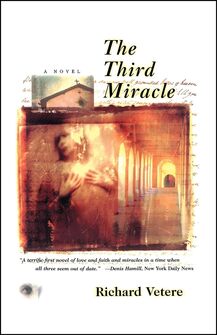
His well-known work is his novel titled The Third Miracle, which he also co-wrote the film adaptation along with John Romano. The film stars Ed Harris, Anne Heche, Armin Mueller-Stahl, Charles Haid, and Barbara Sukowa. Agnieska Holland directed the film while Francis Ford Coppola produced it.
So, take this time to read his thoughts on the anniversary of the film adaptation of The Third Miracle and his experience on the project.
1.Congratulations on the 25th Anniversary of “The Third Miracle” film adaptation, could you talk about some of the memorable moments on set with the director Agneiszka Holland along with the lead actor Ed Harris?
When I got up to the set in Toronto, I remember coming up to Ed and introducing myself. The first thing he said was, "Hey, you're really lucky. I noticed the novel came out in 1998. And here it is—we're shooting the movie, you know, 1998." And I said, "Ed, it took me 10 years to get the novel published." And he smiled.
It was a fun shoot. I wasn't there all the time. It got really cold in Toronto. I'll never forget it. I think it was December 17th. I've never been so cold. We were outside, but that's the last day—the night they wrapped.
Ed Harris: I sat in the dailies with Ed. It was funny because Ed is not a funny guy, and every time there was a blooper in one of the dailies, he tried to make a joke. He turned to me in the dailies and said, "I'm not funny." That was true.
I also saw the film when we screened it at the Toronto Film Festival. I sat next to Ed, and he was quite nervous. You know, when you think about it, there you are, sitting in one of the biggest theaters in Toronto, on one of the biggest screens, watching yourself. He (Ed Harris) was a bit nervous.
But those were kind of my memories: watching the dailies with him and being at the film festival.
2. How would you sum up your experience with the film premiere back in 1999?
The showing in Toronto was great fun. I met the ambassador—one of Canada's ambassadors of the arts—at an event at Lincoln Center, and I told him, "Toronto has the best parties at a film festival." The entire city, basically, celebrates the Toronto Film Festival for three days.
We also had a terrific screening at the LA Film Festival. That was really fun. And then the movie was released. It was an art film with a budget of $7 million—that's all. So, we had Ed Harris and Heche. Anne was really lovely. I met her on the first day, on the set, and found her to be a really warm and likable woman.
Agnieszka Holland is a genius director. Watching her place the camera in each scene was really extraordinary for me. She put it in places I never would have. Talking to her, she did a private screening for me when I was in Los Angeles on one of my trips, and I saw where the movie was going and what she was doing. She needed to do more cutting, that kind of thing. Those are the main things I remember about making the movie.
[On his film cameo]: If you look really closely, I have a cameo. I was on set, and Agnieszka turned to one of the PAs and said, "Get him over here. Put him in a costume." They put me in this leather jacket, and I play a guy getting arrested in the police precinct. You'll see me walking this way, and Anne and Ed walking right past me. So, I have a cameo in the film.
[Background on the genesis of the novel and how it was adapted into a film]:
The process of the movie being made from a novel was pretty interesting. I got the idea for the film in 1985. And for those people who are much younger, the word "miracle" was not used very much in 1985. Spirituality wasn't thought of a lot. I remember the Reagan years, the '80s. There were a lot of drugs, cocaine, and New York City was pulsating with discos.
So, the idea of writing something like this was unusual. It came from a conversation with a very good friend of mine, Rudy Marinelli, who has since passed away. We were talking about the lack of use of the word "miracle." I had no religious notion of pursuing this. It really was, "What is that? Why don't people talk about miracles? Why don't people talk about spirituality?"
So, I went to the library. I just looked up the index cards for books on miracles. The first book I got was a little, thin, black book called The Ordinary Process of Canonization. I had no idea what it was. I picked it up and read the book. The book had a great opening line, and it was, "The Vatican will assign a priest, a postulator, who will investigate the set virtues, the heroic virtues, of the candidate to see if they are a saint. Miracles will be explored."
So, I said, "Oh my gosh, this is a novel." The next day, I took the book home and read it again. The next morning, I started my novel. I wrote the first 100 pages in about a week. But I worked on the book for 10 years because the book was a 500-page mess. It had a great opening and a really terrific ending, but the chunk of the novel was a mess.
So, through those 10 years, my agent got me an interview with a Paramount executive. I walked into her office to pitch some stuff, and she said, "Before you pitch what you came here to pitch, tell me what you have at home in your desk drawer that you didn't come here to talk about?"
And, of course, the first thing was, "Well, I got this mess of a novel called The Third Miracle." And we talked a little more, and that was the end of the meeting.
When I got back to my hotel in Los Angeles, my agent, Mary Manohar, called me. She said, "What is this novel, The Third Miracle? Why had you never told me about it?"
So I said, "Well, because it's a mess, and it's sitting there."
When I got back to New York, I gave it to her, and she started sending it to people. She sent it to Paramount, New Line, Francis Ford Coppola, Baldwin... So, we had this odd bidding war over a novel that wasn't published.
When Coppola came aboard, I got hired to write the screenplay. So, I turned the novel into a three-act-structure screenplay. I cut 200 pages I did not need, and I wrote the screenplay and then rewrote the novel. In a couple of months, the hardcover was sold to Carolyn Graf, and a month later, Simon & Schuster and Scribner got the paperback edition. Then it was sold in several countries.
The novel was published, and it got really great reviews from Publishers Weekly, Library Journal, Kirkus, and others. They were talking about how I sold a novel before the movie was made, but I sold the movie before the novel was published.
I got a call from my agents when I got back to the hotel. This was before cell phones. They told me to pick up Variety magazine. I went to the lobby, picked it up, and on the front page it said, "Harris, Holland, Heche Find Miracle at CAA."
So, what happened was CAA got the script. Morris got the script to Agnieszka Holland, who gave it to her friend Ed Harris. And then, when he said he was in, they gave it to Agnieszka Holland.
Here's the funny part: They lost all the rights to it because they let the option run out. So, we were in the driver's seat. We called them back up, and they had to renegotiate my contract. And about a month later, in Toronto, Ed Harris said to me how lucky I was.
3. What was your favorite scene from “The Third Miracle” when you wrote the book? And what was your favorite part from the film adaptation?
One of my favorite scenes in the novel that did not make it into the film was probably the scene where Father Shore and Roxanna take a walk on the overpass above the expressway at night and talk about themselves. I really liked that scene. I did a stage adaptation of the novel, and that's one of my favorite scenes in the stage adaptation. It did not make it to the screen. But I also like the scene when Frank is out drinking. He's a priest, you know, and he's lonely. He's not in his parish; he's a visiting priest who's been assigned to be a postulator. He gets drunk, goes to Roxanna's door, and knocks on it. That's not in the movie either.
My favorite scene that made it into the movie from the novel is when the statue cries tears of blood. Frank Shore shows up in the rain because the statue only cries tears of blood when it rains. When I wrote the novel, it's the only scene where I thought to myself, "This would make a movie. This would make a good movie scene." And it is in the movie, which I'm really happy about.
Agnieszka shot it from a high angle, looking down at all the parishioners standing in the rain in the schoolyard as Frank goes up the ladder to touch the statue, and he touches the blood that's coming from its eyes as tears.
There are other scenes in the movie that I really like, now that I think of it. There's the scene when little Maria, in the beginning of the novel, is the first one to see the tears of blood from the statue, and Agnieszka shot that in this kind of eerie blue light as a flashback. That's pretty moving and dramatic, actually. I really liked that in the movie.
I also miss the very last scene of the novel, when Frank goes to see Roxanna while she's praying at the statue at the end of the movie. I like it better in my stage adaptation. It's not in the movie at all, but I like it a lot in the novel.
4. From your book, could you please leaf through the pages and point at a random place. What is the full sentence? And what is the page number?
[Hardcover of The Third Miracle, Page 57]:
Father Moore! shouted Father Pollino from below. Frank saw him in the crowd below his window. The rain he smiled his face wet with it. Get under umbrella Alfred father Astacio that the direction freeze. Frank put on his pants shirt and collar and with his coat thrown over his back, raced down the stairs and onto the schoolyard. Everyone was facing the statute. At the front of the crowd was Father Kennedy, down on his knees with his head, bowed in prayer.
Frank looked at the statue and stood bathed in light from the dozen or more flashlights that heat people held up to it. With its arms outstretched and its face and glow from the light, It took on dramatic proportions in the rain. And then there was the blood. Brain could see the dark liquid flow freely from the base of the statue. He pushed his way through the crowd seeing another crowd parted when they saw his scholar. "Bless us. Bless us!" the old and young demanded alike is Frank walk closer to the statue. If the wave his hand and blessing is the pastor and when he reached father Kinley and father Pollino he looked up into the rain. Her tears father Pollino said his voice cracking with emotion as he stepped over to Frank. Frank quickly took his clean handkerchief from his pocket and held out his hand allowing the dark liquid to fall into the white cloth. It was thin and wet like the rainwater, and in the darkness didn't look like wine. Frank folded up the handkerchief and carefully placed it in his breast pocket. He then looked around and saw that many of the faithful, the sick, the dying and the healthy, had bottles cups and glasses, in their hands. Though the tears of blood was small. The people were still fighting their way to the statue to see if they can get a portion of the blessed blood to take home with them. The crowd solely edge forward.
Frank could feel the tenseness in their motions and movements. They all want it to be at the statute speed and collect the precious tiny drops of blood. Frank stepped back and looked up again at the statute. Nearly five foot high when I was right below a window. It was gray and tarnished and whether one Frank had a clear view of the statues each is in the glow from the flashlights and can see the soft lips, cheekbones and eyes. Long hair under the veil fell to both side of Mary's face and our long slender arms reach down as our arms open, palms up pointing to a small globe at her feet. Frank could see where the dark liquid was coming from. The best he could make out was that it was flowing with the rain from the statues from that point of its face, in round, ran down her breast and then divided into three streams to running down neurons one down her thighs and on to her feet, some red flow to a freely to the small globe. "Father Moore!" Frank heard, he turns to see father Kinnaly Who was now standing. "I knew Helen wouldn't disappoint us," he said, smile...
5. On set, besides Ed Harris, Anne Heche and the director, did you meet the other cast members?
Yeah, I met Father Kinnaly, the man who played the pastor, and I met two other actresses. One of them played Maria Kudelski, the mother. We had a lot of fun. When I was in Toronto, we went to the after-parties together. And then there's the other one, Scorsese is her last name. She played Maria Kudelski as a teenager. Now she's an actress who's doing very well. And for the life of me, I can't remember her first name. I think it's Catherine Scorsese. We hung out on the set, and we had lunch together a couple of days as well.
But those are two cast members I know I got to meet, hang out with, and talk with.
6. Francis Ford Coppola produced the film. Did you meet him? Also, was he the person that discovered your book and wanted to adapt it?
I met Francis briefly at a screening, but he was in a kind of a temper because Agnieszka, I think, had delivered a movie that was about three hours long, and they were having a big conversation about it.
But I got to meet Francis more through a silent film about Napoleon. Francis's father, Carmine, put the musical score to the silent film, and he invited me to a big screening. He had a huge screen built in Napa Valley on his vineyard land, and he invited 1,500 people, black tie.
I flew out there to Napa Valley and stayed overnight at the Silverado Country Club. I was writing a series in New York at the time for CBS, starring my friend Danny Aiello, so I got permission to take off for one day. It was on a weekend, luckily.
So, at the end of the night, Sophia I went to the party, and it was amazing. It was really an amazing five-course dinner, five courses of wine. We all sat back watching the movie. I sat with the actor Danny DeVito, and we had a lot of laughs.
So, at the end of the night, Sophia Coppola was there, and Talia Shire, who's in Rocky—she played Rocky's wife—was there. I went over to Francis and asked him, "I got the program, and I want you to autograph it." So, he autographed the program for me.
The Frank Melville Jr. Memorial Library at the Stony Brook campus created my archives in 2005. It's called the [Roofing Material Collection]. So, I've kept that; I didn't give that to the archives. I also have a copy of the screenplay signed by Agnieszka Holland, Harris, and Heche. One of these days, I'll give them to the archives.
So, Francis is an intense guy, and he's, you know, still making movies. So, that's my story with Francis.
7. How many hours a day do you write in general?
When I was a lot younger and starting out, I would do a minimum of five hours a day and a minimum of five days a week, sometimes seven. Now, I work when I want to. The good news is, this is what I do. I have the time, but I also want to put time into other things. I swim, I do sprints and run. I also act; I'm acting more. So, I write almost every day if I'm not traveling, and for me, writing is not writing for hire.
So now, I could—I really don't know; people ask me a lot—I certainly don't put in five hours a day anymore. But I could put in at least two or three hours a day writing. I don't feel the need to stress myself out. When you're a younger writer, you're trying to make a name for yourself. You're trying to make a living. So, you write and write and write. And so many things you write never get anywhere.
Now, I spend a lot of time talking about what I've written. So, that's one thing for sure. And I go to the theater a lot. I go to screenings with the Writers Guild. I'm a lifetime member of the WGA East. I'm a playwright. So, I mean, rehearsals—I have a little 10-minute play running in a big festival now, so I've been going to that, you know, plus rehearsals in person and on Zoom.
You know, there's a lot. It's always something going on.
8. Which novel/novella/short story/article have you read that you would like to see a film or TV series adaptation?
Well, I would love to see all of my novels turned into movies. Unfortunately, everyone who's in the business says the movie business has changed drastically. I've been told this by people who have made a lot of movies. I'm lucky that I have about five movies and teleplays, but my novel The Writer's Afterlife—I would love to see that made into a movie. It's really finding young critics, and it came out in 2014 with really great reviews from Publishers Weekly. But now young critics online are really loving it and saying some wonderful things about it.
I'd love for someone to hire me to write The Writer's Afterlife screenplay. Then there's Champagne and Cocaine, about New York City in the '80s. My new novel just came out, She's Not There. I'm doing a book signing at the City University of New York on March 25th. On April 9th, I'm doing a talk at the New Trauma Bookshop in New York City for My Place of Water, which was published in 2019. And we're looking right now to get an Off-Broadway production. I have attached Len Cariou, who won a Tony for Sweeney Todd, and the actor Mike Faist, who's from The Immigrant. So, I'm trying to get that together and talking to people all the time about getting that done.
So, there you go. There's a lot of that, and it takes up a lot of time when you can't write. I just love these novels, like those of old-fashioned writers such as John Updike and Norman Mailer, and, you know, all the hours they poured into writing and writing. It's not easy. I believe you've got to pace yourself.
I just had my novel She's Not There published a couple of months ago. I never thought I'd get it published, but I did. And actually, it happened pretty quickly, but I had to rewrite it and have it sit there for three years before I could figure out how to fix it. And then one day I picked it up and read it and said, "Oh my God, it's fixed." I don't remember going into it. I sent it out, and the first publisher loved it and said, "We want to publish it." So, it's always full of surprises.
9. What advice would you give to someone that would like to see their short story or novel being made into a film or TV series? Do you think it’s easier for them to write a screenplay version and send it out or have someone in the industry to read the source material to determine whether the story will make a compelling film or not?
It's changed now. Of all the films I've worked on, only one was an original screenplay. For A Date with Queens, with Jason Alexander, someone saw my play running in LA and then hired me to write the screenplay. Someone saw a play at the Actors Studio, a play called Rockaway Boulevard, and they hired me to write Vigilante. The Third Miracle was a novel, so I have written some screenplays on my own.
In fact, my screenplay about Caravaggio won the Beverly Hills Golden Palm for Best Screenplay. So, my recommendation is: there's no one answer, but there are things you can think about.
Number one, become a director. Learn how to direct. It's not easy because you really need to know the technical skills, and that's nothing like writing. Or find a director who loves to direct but doesn't write. Think about that. Most directors today write their own material.
I would say, even with films I've won awards for at film festivals, I could not get someone to make the film. So, it's really difficult. Probably the best thing to do is write a good screenplay—a really good screenplay—and show it to as many producers as possible. They may not make your screenplay into a movie, but they may hire you to write one that they want to make into a movie.
In other words, I think a good sample script can get you attention, whether for a TV series or a movie, because the craft of writing a screenplay is not easy. It's not an easy thing. Just write a really, really good screenplay. In other words, your first act, second act, third act, terrific characters—understand story and plot—and somebody will hire you.
I got hired to write a lot of stuff that was never made. But Vigilante was made. It was flown to Paris, where they put me up for three months writing movies. I was flown to Rome and lived there all summer, writing movies. So, you can do this for a living. I have. If you write a good screenplay, you can do it.
The hard part is, you may understand the craft, but are you going to come up with a story? Are you going to come up with a story and characters people care about? That's the question. And then find a director whom you like, who likes your story and wants to make it, or collaborate on something else.
It's a long, long journey. To me, it was worth it, but it's a long journey—sometimes a lot of fun, and a lot of disappointment on the other hand.
10. If you had your own talk show, who would your first 3 guests be?
I’d probably go back a bit in history. I don’t even think I could pick just three, but off the top of my head, William Shakespeare, because I have a lot of questions about playwriting and his life. Even though I’ve written a lot about Caravaggio, I’m not sure if I would want to talk to him.
They’re all going to be British... probably the poet Lord Byron or John Keats... and maybe one of the Brontë sisters.
11. “The Third Miracle” was selected “The Book of the Month” in Spain and Poland, could you talk about how you first heard the news about your novel getting such a recognition?
It was really cool. What I enjoyed most was that they all had very interesting book covers. The Polish covers—there were two or three—were really nice. One had the actors on it, and another was a beautiful design. And in Spain, all three were really gorgeous.
It was really nice to have your work translated and to see that it was Book of the Month. It was also a Book of the Month Club selection in Greece, translated into Greek, but it didn't do as well in Greece as it did in Poland and Spain.
I'm hoping to get a trip to Poland soon with a production of my play. I want to see how the novel is doing there and see if I can do a reading. So, that was kind of fun.
I know the movie is really held in high regard in Poland, and I have a feeling it's the same in Spain, too. I'm going to be there soon because they asked me to be on the screenwriting panels.
12. What are looking forward to this year in Spain?
Well, the reason I'm going to Spain is because I'm an actor in Jordi Turon's Third Week. I'm in a supporting role, but I think it's going to be cool because, for those of you out there who are writers, you can go to a film festival and nobody cares about the writers of the movies, but they're always interested in the actors. And I'm already—you know, I've got so many interviews set up. They just sent me the schedule today. And I hope I have time to sleep.
We land in Barcelona, then I get on a screenwriting panel, and then, early the next morning, we're on a train going to Madrid for press and a screening of the movie there in Madrid. Then we go back again, and that's a two-and-a-half-hour train ride. And then there's the big screening at the festival the following night. But I do believe there's press all day Friday and Saturday, and I want to see some other movies. I want to go check out some of the other films. So, the fun part about going there is that, you know...
I was the Latino screenwriting mentor for the lady who was one of the producers of Pan's Labyrinth, Bertha Navarro, and she flew me to Oaxaca, Mexico, along with a handful of other screenwriters, where we mentored Latino writers. The last time we did that, I was in Ecuador.
It's interesting because American screenwriters are really good at structure—really good at structure, for years. And I felt like the other filmmakers had wonderful movie ideas and wonderful scenes, but they always needed mentoring on how to structure their screenplays. And I had a great time doing that. Plus, they really took care of you, and I got to see some amazing things, like Oaxaca. The pyramids were stunning, and Ecuador is just beautiful. I was in Cuenca, and they took me up into the Andes, so it was pretty amazing.
So, being a screenwriter, you get to see the world, or at least I do, and Vigilante's success really brought that, and so did The Third Miracle's success. Not in America as much, but around the world, The Third Miracle got me a lot of attention.
With Vigilante, there's still a cult following, you know. They're still screening it. They just had one at the National Theatre in Prospect Park in Brooklyn, and there's one in Williamsburg every year—a screening of Vigilante. So, Bill Lustig, the director and producer, and I will go there. Robert Forster, who starred in it, passed away. So, I think Andrew Garroni and I were two of the three still alive who talked about the movie and the people who were behind the scenes.
So, it's fun being a screenwriter. It's been a lot of fun. And now, as an actor, it's really fun because, when I'm there, they always ask me questions about screenwriting.
13. [This interview was before Oscars Night]: Last question, which film do you think would win Best Picture and Best Director at the Oscars?
I think this one, for the first time, is easy for me. I think it's Oppenheimer, and I think it's Christopher Nolan. I saw Oppenheimer twice. I went when Christopher Nolan gave a talk afterward. His talk was not helpful at all. He didn't really have anything new to say except one thing: that his screen directions on his scripts—and he called them stage directions—were all written in the first person. I was still confused by that, so it wasn't very helpful. I shared that with my students, who said, "I really can't help you."
I like Barbie. I thought it was fun. But I think Oppenheimer follows the rules of a good screenplay. Within the first 10 minutes of the movie, he's trying to get his clearance back. That's when he's in the office, and then the entire movie flashes forward and back to why he's going to get his clearance either denied or accepted. We see his life, what he deals with, and who he is.
So, I thought Oppenheimer was terrific, and Christopher Nolan directed it with such a strong metaphor. I can't write without a title because the title is my metaphor for my story. So, when I get lost in my story, I just remember what it's about, which is my metaphor. I try to have a conceit in my story so that I don't get lost.
I don't believe in writer's block. I think writer's block is really a writer not doing their homework. I write a one-sentence description so I'm really sure what my story is about and what the metaphor for the story is.
So, I think Oppenheimer is about Oppenheimer. It's about a man who makes the most dangerous weapon ever created and his struggle with that. So, I think that might win. And I think Christopher Nolan is going to win because it's a totally unforced directing job. It really is. I think.
But I just had dinner with some people, and they said they have trouble finding titles. I love my titles. I gave a talk at the Authors Guild, and one of the things someone spoke up and said, "You have the best titles." And I said, "Thanks."
But I remember writing The Third Miracle after reading that book, and that week I wrote the first 100 pages. I got a piece of paper, and I started writing. I started the first chapter, and I knew at that time—because it's since been changed—that you needed three miracles for someone to be considered a saint. So, one of those 10 titles was The Third Miracle. And I said, "That's my metaphor. That's my conceit. That's my story."


 RSS Feed
